Thursday, November 14, 2013

"The Sound of a Voice"

Hello, this is henry here.
I have been pondering the play "The Sound of a Voice" and I have come up with a few ideas.

The man is trying to forge an identity for himself.  He wants to be a strong, independent, manly character.  He doesn’t like it when the woman tries to take care of him because he can’t be independent.  In many areas the woman’s strength, skill or wisdom is superior to the man’s.  This contradicts the image that the man is trying to create for himself.  When the woman takes the man’s sword away because she is afraid he will hurt himself, the man finally feels that he has been defeated; the woman took away part of his independence and now the man feels he is in serious danger of being peacefully imprisoned.  He comes to overpower and defeat a witch, but finds himself powerless against the woman’s attempts to care for him. He ultimately feels he must “leave in shame” because he is neither able to defeat the woman, nor relinquish his strong, independent identity.

What the woman wants in the play is to have a human companion to be with and care for.  She wants “an escape” from the cycle of visitors coming, staying for a while, and then leaving forever.

What the man wants is to be strong and independent.  Later in the play this is complicated by the fact that he grows to care for the woman.  He has an internal struggle between his natural desire to shape his identity, and his desire to be with the woman.

At the end of the play, the man is put into the woman’s place.  Since the woman is now dead, he is alone.  He tries to play the Shakuhachi to relieve his loneliness.  I believe that he will take the woman’s place and become the one longing for the sound of a voice.  This cycle will continue indefinitely.

Tuesday, November 12, 2013

Poetry


Hello all, this is Henry here.
I have recently read several interesting poems, and I decided to write a post  about poetry.

Poetry is a very powerful medium of communication because it appeals to our emotions and our subconscious.  Because of this poetry can be much more persuasive than simple logical argument.  It is also very useful for describing ideas that are hard to express rationally, such as the authors fears or wishes.  If poetry is stripped of its descriptive, vivid words and expressed in straightforward language, it loses its persuasive power to disarm the reader through emotion.


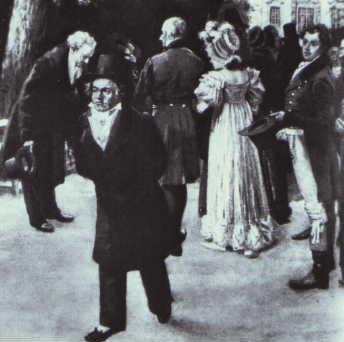
For whatever reason,
               I am reminded of Beethoven
                by the title "Walking Around"

For example, “Walking Around” by Pablo Neruda is a poem with very dark themes that are hard to explain rationally. The descriptive language of the poem conveys the author’s feelings, although it would be difficult to say exactly what those feelings are and where they come from in simple words.

Despite the fact that I found this poem to be a little depressing, I still admire the power of phrases such as “certain streets hideous as cracks in the skin” and “The smell of barbershops makes me break into hoarse sobs”.  These phrases tell me how Neruda is feeling far more effectively than just stating “I am feeling dark emotions”.


A poem is like a jigsaw puzzle; it is composed of fascinating, interlocking pieces which are put together to reveal a picture.  I find poetry entertaining because I enjoy both listening to the vivid, interlocking words, and trying to discover and understand the author's message.


Here is a link to "Walking Around": http://www.poemhunter.com/poem/walking-around/

Monday, November 4, 2013

Dialectical Materialism


Hello, this is Henry.
I have recently been reading “Persepolis” by Marjane Satrapi for my English 1A class.  In “Persepolis” young Marjane’s parents are Marxists.  Marjane is given a comic book called “Dialectic Materialism” which becomes her favorite book.  So what is Dialectic Materialism?


 Dialectic Materialism
Dialectical Materialism is a philosophy that Karl Marx developed to explain his socio-economic ideas.  As its name suggests, it is a combination of Dialectics and Materialism.
Dialectics is a method of argumentation in which two people (or groups) who disagree use reasoned arguments to arrive at the truth.  It is unlike other forms of discourse in that arguments are based on logic rather than on emotion or ethics. This method originated with the Greek philosophers, especially Plato, Socrates, Aristotle and Zeno.  Dialectic argumentation has been - and is still – widely used in the Western world to resolve disputes and advance our knowledge.
            Materialism is the concept that the universe is composed solely of matter or energy.  It admits the existence of thought and the metaphysical only as a product of matter.  Materialism is contrasted with idealism, which holds that the universe is composed solely of mind or spirit, and that the material is only a product of the mind.  Materialism revokes idealism, claiming that the world is made up of the material, not the mental.
            Marx combined these two ideas to form his philosophy of Dialectical Materialism in order to describe historical change as the result of conflict over material goods.  Here is an example of Marx’s ideas that illustrates Dialectical Materialism:  He believed that all societies undergo changes that are a result of tension between members of society that have wealth and those that do not.  Society in its primitive form is one in which material goods are communally owned but there is generalized poverty.  People who don’t have enough want more and this conflict produces another stage in the development of society:  private ownership and more wealth.  Because the wealth is in the hands of only a portion of the population, another round of conflict produces the final stage in society’s evolution:  communal ownership of generalized wealth.  

Thursday, October 24, 2013

Introductions


Hello, I am Henry Gardella.  Currently I am reading the graphic novel "Persepolis" for my English 1A class.
IMG_20131024_122630.jpg


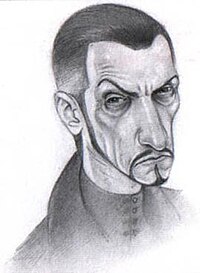
You have an appointment with the patrician...
Lord Vetinari.jpg

I am Lord Havelock Vetinari, the Patrician of the city of Ankh-Morpork.
I am a cynic and my family motto is "Si non confectus, non reficiat" (If it ain't broke, don't fix it).  I believe that what people desire in life is not money or power, but for things to stay the same.